What Is IMSI in SIM Cards and eSIM: A Traveler's Guide
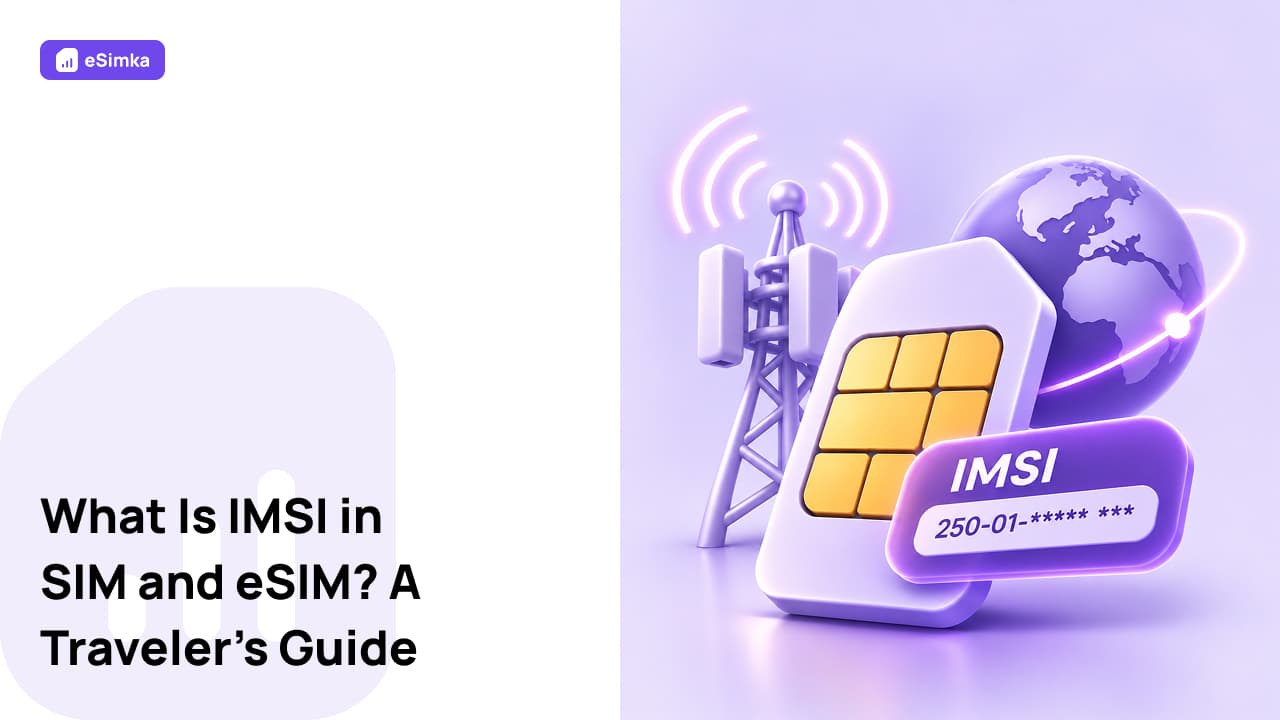
When a smartphone searches for a mobile connection abroad, local base stations request a 15-digit sequence from its chip. This is the International Mobile Subscriber Identity, which is used to identify a subscriber on the network. The way IMSI works answers a common question: why does a connection appear within seconds with one travel profile, while another leaves you without internet right at the arrival airport.
What Is IMSI in Simple Terms and How Does It Work in Roaming?
Travelers regularly search online for what IMSI is on a phone and why they need to understand it before a trip. Essentially, it is a digital equivalent of a passport, stored not on paper but directly in the communications chip. A regular phone number with a country prefix is not used at all when the phone first contacts a cell tower. Mobile network equipment communicates directly with its internal databases. The smartphone's radio module transmits a 15-digit sequence over the air. The network node at the cell tower detects this signal and checks the data against its internal databases.
Within the home network, this check happens instantly. The cell tower recognizes the code, checks the account against the home HLR (Home Location Register), and immediately registers the device on the network.
When traveling to another country, the verification chain becomes longer. As soon as you turn off airplane mode after landing, the phone starts searching for a signal from the nearest base station. The guest network reads the IMSI and understands from the first digits that it is dealing with a foreign subscriber. It then sends a request to your home provider for access authorization. If the providers have a roaming agreement, the guest VLR (Visitor Location Register) creates a temporary record and enables data transmission. Without such an agreement, the smartphone screen will display “Emergency calls only.”
What Is the IMSI Code Made Of: MCC, MNC and MSIN Explained
When the GSM standard was created, engineers built a clear geographic association into this number. According to ITU-T E.212, the full sequence contains a maximum of 15 characters. However, shortened 14-digit numbers can still occasionally be found on older equipment. Each digit has a specific position — together they determine the path of the signal between countries and mobile networks.
- The first three positions contain the MCC (Mobile Country Code). This country code is permanently associated with a specific country. For example, Russia uses 250, Germany uses 262, while the US uses 310 and 311.
- They are followed by two or three MNC (Mobile Network Code) digits. These characters identify a specific mobile operator within the country to the base station. European networks usually use two digits, while North America uses a three-digit format.
- The remaining 9–10 positions contain the MSIN (Mobile Subscriber Identification Number). The provider writes this part of the number to the card when it is issued. This ensures that a specific mobile plan is not confused with millions of other contracts in the same database.
The combination of MCC and MNC forms the PLMN (Public Land Mobile Network) identifier used for initial network identification. Using these first five or six characters, a smartphone searches for a network abroad: it scans the airwaves and compares detected cell towers with the list of partner networks stored on the chip.
How Is IMSI Different From Other Mobile Identifiers?
Smartphone network settings contain many similar abbreviations. Let's look at what IMSI means on a phone compared with the other serial numbers that manufacturers and mobile operators store in your device.
IMSI vs. IMEI: Subscriber Profile vs. Smartphone Code
Users often do not see the difference between them, even though one parameter belongs to the mobile plan and the other to the device itself. The IMEI (International Mobile Equipment Identity) is permanently associated with the smartphone's hardware. It is printed on the box at the factory and stored in the modem. If a phone has two physical SIM card slots, the device will also have two factory identifiers. You can remove the SIM card from the tray and throw it away — the hardware IMEI will remain unchanged.
The IMSI, on the other hand, is stored directly on the physical SIM card or in the memory of a downloaded digital profile. If you move the card to another device, the subscriber identifier used for network identification simply moves with it. The base station will then record a new code for the smartphone itself.
IMSI, ICCID and EID: The Difference Between Physical SIM and Digital eSIM
A sequence of 19–20 characters is printed on the plastic frame of every new SIM card. This is the ICCID — the technical serial number of the physical card itself or the downloaded digital container. Logistics services use this number for standard inventory tracking. When a plan is activated, the billing system links this serial number to the IMSI of the specific subscriber.
When smartphones began using built-in radio modules, the EID (eUICC Identifier) was added to the list of parameters. This 32-character string uniquely identifies the physical eSIM chip soldered onto the motherboard. The EID itself never changes, but the chip's memory can hold up to five different travel plans at the same time. Each profile is assigned its own ICCID and a separate IMSI for connecting to the mobile network.
Multi-IMSI Technology in Travel eSIMs: How the Best Plan and Network Are Selected
The memory of a standard physical SIM card can hold only one subscriber profile. Suppose that in your destination country, your home operator has an agreement with only one local company. If its tower goes down in the mountains, you will be left without maps and navigation. You cannot manually select another tower in the phone settings: foreign equipment will reject the request because there is no roaming agreement.
Travel connectivity engineers solved this problem with Multi-IMSI technology. When an eSIM profile is installed using a QR code, a package of identification data for different countries and partner networks is loaded into the device's memory. A small service program — an applet — runs in the chip's memory. Its task is to continuously monitor signal quality.
Signal strength drops on the coast? The firmware automatically switches the active IMSI to a backup option stored in the chip's memory. The radio module restarts the connection, sends updated parameters to the base station, and connects to another local tower with stable coverage. In the еСимка service, such multi-profiles work in more than 150 countries. The plan is paid for with a Russian card before departure, and the code can be scanned without visiting a mobile phone store — after arrival, the chip automatically connects to a working operator.
How to Find Your IMSI on iPhone and Android and Set Up a Profile
OS developers remove this item from standard settings so they do not overload the interface with unnecessary technical numbers. To check what country is associated with your travel plan through its IMSI, you will need short service codes or third-party utilities.
- On Android smartphones, open the dialer and enter the service code ##4636##. A hidden engineering menu will appear on the screen. Open the “Phone information” tab: the parameter used for network identification will be listed among the radio module characteristics. Smartphone manufacturers often disable access to service codes at the firmware level. In that case, free utilities from the Google Play catalog can help — for example, SIM Card Info or Network Cell Info.
- On iPhone devices, Apple's rules prevent App Store applications from directly accessing low-level modem data. In the standard Settings — General — About section, only the ICCID and EID numbers are displayed. However, the first five IMSI digits (the MCC and MNC codes) can be viewed through the Field Test menu by entering 3001#12345# on the keypad and pressing the call button.
- When setting up a travel profile from еСимка, however, you do not need to look for these parameters in the engineering menu. The QR code for installation arrives immediately after payment. Simply scan it with your smartphone camera and enable data roaming for the added plan. All network settings will be loaded automatically, while the home SIM remains active for incoming calls and bank SMS messages.
Travel Security: Signal Interception and SUCI Protection in 5G
The architecture of 2G, 3G and 4G LTE networks originally contained one vulnerable point. When you turn on your phone in a new location, before encryption is established, the modem has to transmit its IMSI in plain text over the radio channel. Later, the base station assigns the phone a temporary TMSI pseudonym, but the initial contact takes place without protection.
This is what fake base stations exploit — security specialists call them IMSI catchers (Stingray). A compact device in an ordinary case imitates the signal of a powerful cell tower. Nearby phones attempt to register with it and transmit their permanent subscriber numbers themselves. This can be used to determine when a specific person enters a building or force the connection down to the older 2G standard and intercept traffic.
Engineers from the 3GPP consortium managed to eliminate this vulnerability only with the fifth-generation standard (5G Standalone). The phone no longer sends the number in plain text, but instead packages it into the SUCI (Subscription Concealed Identifier) cryptographic container. Before transmitting it over the air, the modem encrypts the permanent number on the card's chip using the home operator's public key. The interceptor sees only a random stream of bits over the air. Only the home network core can decrypt the record and match it to the actual subscriber.
Frequently Asked Questions (FAQ)
If my phone has two SIM cards, does it have two IMSIs?
Yes, and there can even be more than two. Each physical card carries its own subscriber code, and if you use a smartphone with a built-in eSIM module and have loaded four travel plans for different trips, the phone's memory will contain four different digital profiles with their own identifiers (usually only one or two remain active on the network at the same time, depending on the device model).
When will I need my IMSI number?
In 99% of everyday situations, you do not need it. Your provider's support service may request this parameter for detailed diagnostics, for example, when your smartphone can detect cell towers abroad but the base station repeatedly rejects its registration for data transmission.
Can I share my IMSI?
You should not post this code publicly on forums. If attackers have access to vulnerable nodes of the SS7 signaling network, they can technically use the combination of a phone number and permanent subscriber identifier to determine your location with cell-tower-level accuracy or intercept incoming SMS messages.
Can I make a call using an IMSI?
No, you cannot dial these digits through the phone's dial pad. Calls and SMS messages use the regular subscriber number in E.164 (MSISDN) format. The operator's switch links it to the card's technical number within its own database.
Can I change my IMSI?
You cannot manually change these digits on a standard physical card — they are written at the factory and cannot be rewritten. A new code is issued only when you replace the physical SIM card at a mobile phone store. The second option is to delete the old eSIM profile in the smartphone's menu and load a new one.
What happens to the IMSI when I transfer my number to another operator?
Once the number transfer under the MNP (Mobile Number Portability) procedure is completed, the old code is deactivated. The new provider issues its own physical card or digital profile. It contains its network code (MNC) and a new subscriber number, which the billing system associates with your existing phone number.